
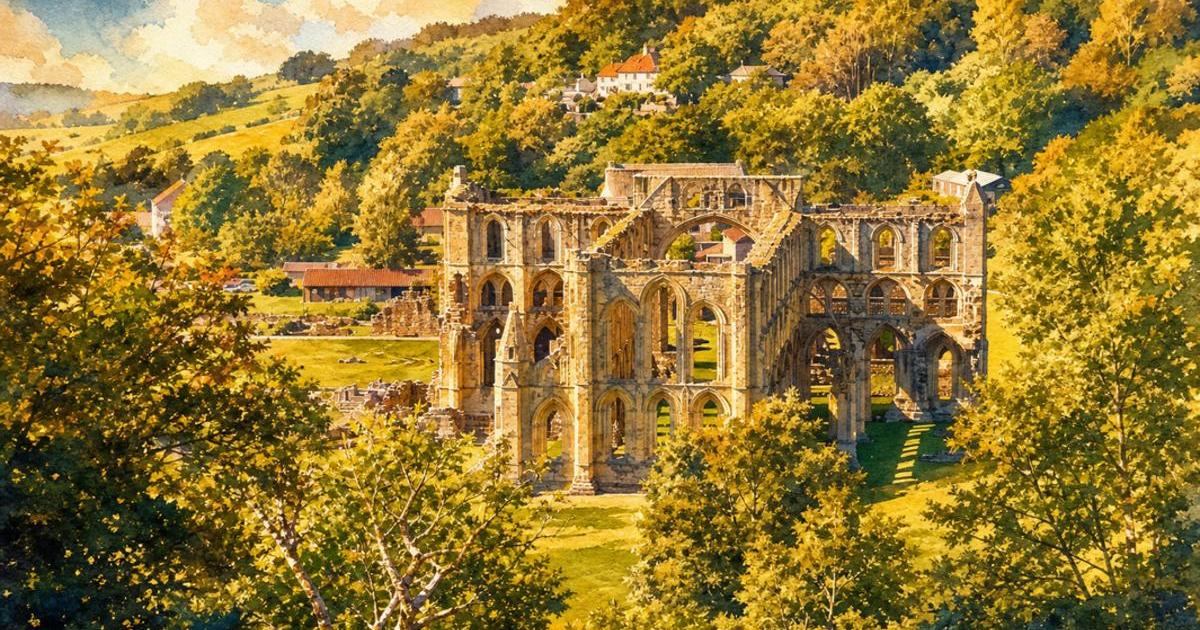
Photo: Wehha / Wikimedia Commons (CC BY-SA 3.0)
About this place
Rievaulx Terrace is a curved grass walk set above the ruins of Rievaulx Abbey in North Yorkshire, created in the eighteenth century as part of the Duncombe Park estate.
The design was deliberately conceived so that the medieval abbey ruins could be viewed from above as a picturesque feature in the landscape, placing it firmly within the English tradition of incorporating romantic ruins into a landowner's grounds.
Two classical temples stand at opposite ends of the terrace, serving as ornamental focal points for the walk.
The National Trust looks after the property.
Read more on WikipediaHistory
The terrace was laid out in the eighteenth century as part of the wider Duncombe Park estate, designed so that the medieval ruins of Rievaulx Abbey could be viewed from above as a picturesque feature in the landscape. It formed part of a broader tradition of English landscape design in which romantic ruins were incorporated deliberately into a landowner's grounds.
Architecture
Two classical temples stand at opposite ends of the curved grass terrace, serving as ornamental focal points for the walk.
Gardens & grounds
The terrace itself is the principal draw, a long curved grass walk with managed views down into the wooded valley where the abbey ruins sit.
Facilities
Plan your visit
Nearest station: Thirsk Rail Station (10.6 miles)
Open seasonally; check the National Trust website for current opening dates and times.
Nearby properties
Historic places nearby
Within 5 miles of Rievaulx Terrace (YO62) there are 5 historic properties, including 2 historic buildings and 2 historic houses, across English Heritage and Historic Houses sites.
Within 10 miles of Rievaulx Terrace (YO62) there are 9 historic properties, including 3 historic buildings, 3 historic houses and 2 churchs, across English Heritage, Historic Houses and Churches Conservation Trust sites.
Within 20 miles of Rievaulx Terrace (YO62) there are 29 historic properties, including 10 historic houses, 9 historic buildings and 4 churchs, across English Heritage, Historic Houses and Churches Conservation Trust sites.
Facts
A Georgian landscape walk built specifically to frame a ruined medieval abbey as living scenery.
- Type
- historic building
- Location
- North Yorkshire, England
- Visit duration
- Allow 1–2 hours
Featured in Hidden Britain
Get Hidden Britain
A free weekly newsletter on Britain's overlooked historic places.